The science and the session
The closed loop — how it works.
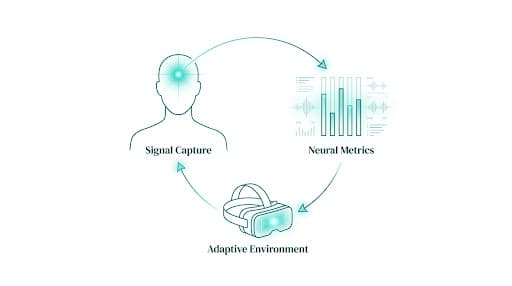
EEG reads the brain state. The VR environment responds to it. The loop closes — and the work of change becomes something you can see, not something you hope is happening.

The session arc
Four phases. One coherent experience.
Every LiberateOS session follows the same arc: notice the signal, practice with it, reflect on what shifted. Repeatable. Measurable. Safe for clinic operation.
- 1
Onboarding
The clinician creates or locates the patient's pseudonymous profile in the Provider Dashboard, records per-session consent, and reviews any prior session notes or contraindications. The patient is briefed on what to expect. This takes two to three minutes.
- 2
Calibration
The EEG headband is fitted and signal quality is confirmed. The system then reads a short baseline — typically two to three minutes — in which the patient sits quietly and the system establishes their individual calm and focus signatures at rest. This baseline is recalibrated at the start of every session.
- 3
VR session
The patient puts on the Meta Quest VR headset and enters an adaptive environment. The environment responds in real time to brain-derived calm and focus metrics: when a calm, focused state is detected, the environment enriches; when cognitive load rises, the environment simplifies and quiets. Sessions typically run for 15–25 minutes. The clinician monitors from the dashboard; no manual adjustments are needed.
- 4
Review and reflection
After the session, the dashboard shows a summary of calm and focus trends, notable peaks, and comparison to prior sessions if available. The clinician uses this data in a debrief conversation. A patient-facing reflection summary is generated for the patient's own reference.
How the system works
EEG → metrics → adaptive VR.
The core of LiberateOS is a closed feedback loop: the brain state drives the VR environment, and the VR environment reflects that state back in real time — giving the patient something to practice regulating, session by session.
EEG signal
A consumer-grade dry-electrode headband reads raw brainwave patterns from the patient's scalp. No gel, no clinical preparation. Signal quality is confirmed before each session.
Derived metrics
The raw EEG signal is processed to derive calm, focus, and cognitive-load indicators — calibrated against the patient's own individual baseline, not population norms. These are the metrics the clinician reviews post-session.
Adaptive VR
The virtual environment responds to the metrics in near-real time. The feedback is subtle and non-intrusive — no scores, no alarms. The environment simply becomes richer when the target state is detected and quieter when it is not.
LiberateOS uses consumer-grade EEG hardware. The derived metrics are indicators of general cognitive state relative to an individual baseline — they are not clinical-grade measurements of any specific condition.
Evidence-aware
What the science supports — honestly.
Neurofeedback has a serious research base and a history of overclaiming. We try to hold the line between the two.
A real-time reflection, not a shortcut
Resting-state alpha activity is a well-documented signature of calm, relaxed wakefulness — that part of the science is old and solid. What we are careful about is the next step: LiberateOS does not claim to open a specific 'brain window' on demand. What it does is give your patient a real-time, personally-calibrated reflection of their own arousal state, and a concrete technique — paced breathing — shown to help regulate it in the moment. The signal is real. The claim stays exactly that size.
What the evidence actually supports
The mechanism we lean on hardest — slow, paced breathing to reduce arousal — has strong, independent evidence behind it; that is the behaviour the system actively coaches. The wider neurofeedback-for-attention literature is smaller and more mixed than most marketing in this category admits: recent reviews find modest, inconsistent effects overall, no significant pooled effect when compared against sham conditions, and no significant benefit specifically for alpha- or SMR-based protocols — the approach closest to our Calm scenario. We say that plainly because it is true — and because an inflated claim, repeated by a well-meaning practitioner to a patient, is the actual risk we are both trying to avoid. What we stand behind: an honest, real-time reflection of your own state, and a technique genuinely shown to calm the nervous system in the moment.
What we claim
We use language like 'supports focus and calm' and 'may help build self-regulation.' We do not claim to treat, diagnose, cure, or re-pattern anything. LiberateOS is a wellness tool — a structured, brain-informed experience that complements clinical practice.
LiberateOS is not a medical device and does not make clinical or therapeutic claims. All session outcomes described are general wellness indicators, not medical measurements.
Where we draw the line — on purpose
Three things LiberateOS is not. We state them plainly, in the same place as everything else, because a boundary you have to hunt for in small print isn't a boundary you can trust.
Not a medical device
We built LiberateOS to be honest about what a four-channel signal can and can't tell you.
Not a diagnostic tool
We report relative, personally-calibrated indicators — not diagnoses, on purpose. Treating them as more than that would mean overselling a wellness signal to people making real decisions about their wellbeing — and that's not a trade we're willing to make for a bigger claim.
Not a cure
We're a practice space, not a promise. What the dashboard shows is a snapshot of this session's signal — not a verdict, and not a guarantee of what next time will look like.
LiberateOS is not a medical device and does not make clinical or therapeutic claims. All session outcomes described are general wellness indicators, not medical measurements.
The metrics clinicians review
A relative indicator of the patient's relaxed, low-arousal state during the session, calibrated against their individual baseline.
A relative indicator of attentional engagement during the session. Higher focus correlates with the environment's responsive enrichment phase.
An indicator of overall mental effort. Elevated cognitive load typically corresponds to the environment's simplification phase. Tracking load across sessions can inform session length and scenario selection.
What the evidence actually supports
What the science supports — honestly.
Neurofeedback has a serious research base and a history of overclaiming. We try to hold the line between the two.
The metrics clinicians review
After each session, the Provider Dashboard shows three key indicators derived from the session EEG data. These inform the clinician's debrief conversation — they are not diagnostic outputs.
- Calm score
A relative indicator of the patient's relaxed, low-arousal state during the session, calibrated against their individual baseline.
- Focus score
A relative indicator of attentional engagement during the session. Higher focus correlates with the environment's responsive enrichment phase.
- Cognitive load
An indicator of overall mental effort. Elevated cognitive load typically corresponds to the environment's simplification phase. Tracking load across sessions can inform session length and scenario selection.